
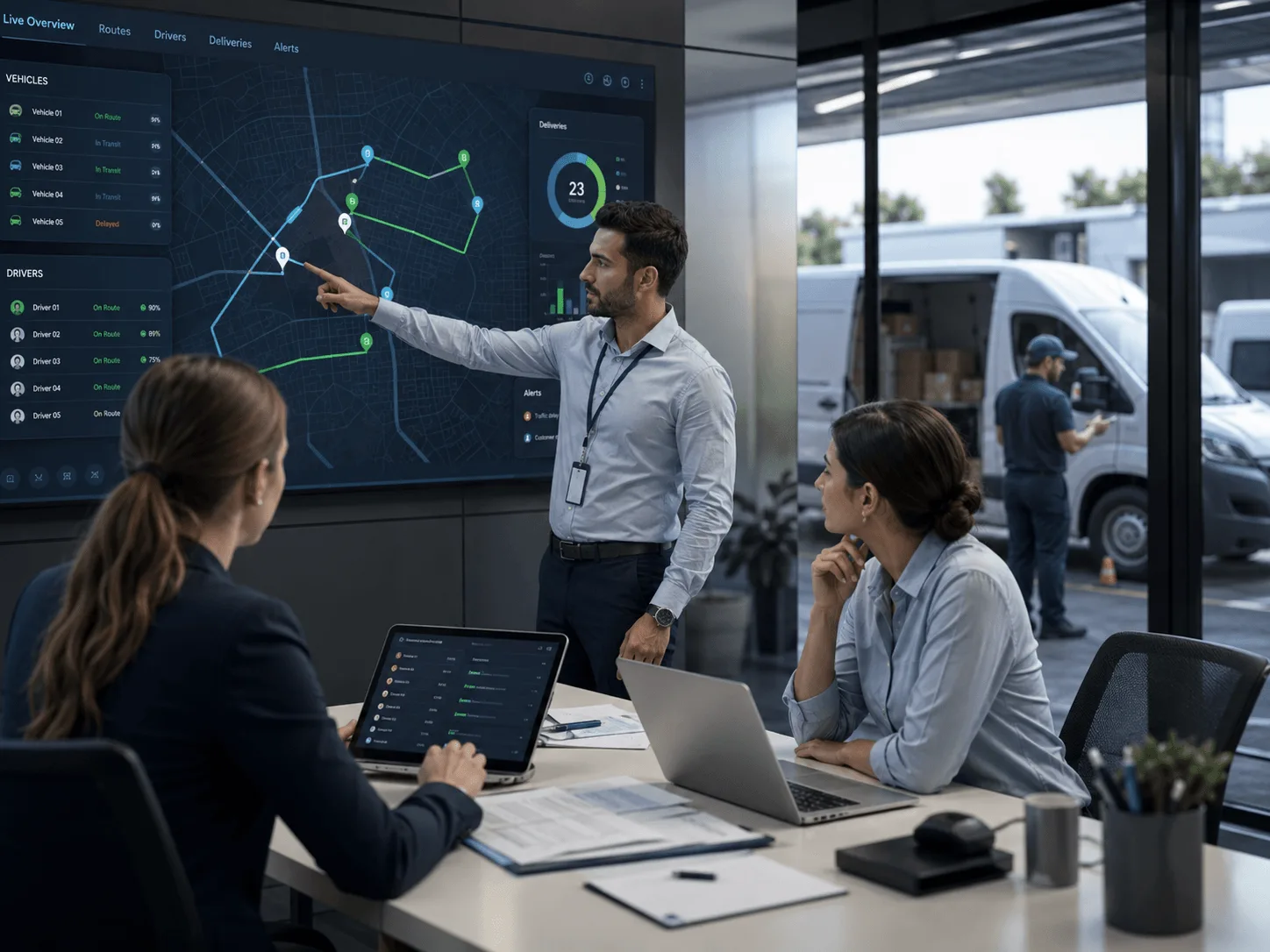
In an earlier article we outlined QDelivery's approach to making delivery visible and the operations it serves. This time we change perspective and look through the eyes of the operations team: which stages does a delivery day go through on QDelivery, which decision is made at each stage, and what data are those decisions based on?
QDelivery is a platform that manages delivery processes end to end with business intelligence. It brings planning, routing and live field coordination together on a single platform, using efficiency- and cost-driven calculations.
Who it is for: operations bound to speed and volume
QDelivery was designed for operations that must reach their customers on time and that treat delivery as part of how they compete. Each of these operations expects something different from planning:
- E-commerce and marketplaces: Volume fluctuates during the day and in campaign periods. The plan has to keep the same-day and fast-delivery promise despite these swings.
- Grocery and food: Freshness and time are critical. Deliveries are organised around hour-based time windows.
- Restaurant chains: Multi-branch service networks race against minutes at peak hours. The ability to rebuild the plan quickly is decisive.
- Enterprise distribution: For large organisations running planned shipments from many points, the priority is distributing capacity correctly and keeping shipments traceable.
These different needs are met on the same infrastructure; what changes are the constraints that dominate planning and the indicators being tracked.
The end-to-end flow: a delivery day in seven stages
On QDelivery, delivery runs as an uninterrupted process in which each stage triggers the next. The seven stages below summarise the flow the operations team manages throughout the day.
1. Order intake
Orders arriving from different channels are gathered into a single pool and prioritised. They are processed automatically, and an estimated delivery time is calculated for each one. The promise made to the customer therefore rests on a realistic basis from the very first moment.
2. Planning and routing
The distribution plan is built automatically by weighing capacity, zone, traffic and time windows together. Smart route optimisation balances these constraints and looks for the best split between efficiency and cost. The planner's job is not to place every delivery by hand but to review the plan the system proposes and manage the exceptions.
3. Assignment
The plan reaches the field as courier and vehicle assignments. Because assignment is part of the same flow as live tracking and proof of delivery, who a delivery was given to, where it is and how it was closed can all be followed through a single record.
4. Field
Once a delivery is on the road, the status of teams, vehicles and shipments is tracked in real time. The field and the control room see the same picture: the centre does not need to phone the field to ask for status, and the field team carries out the day's deliveries and handover steps within one flow.
5. Live tracking
Couriers and shipments are followed on a live map. The customer also sees the delivery in real time and is kept informed by SMS notifications. The operations team and the customer see the same moment, so the question "Where is my order?" is answered before it is asked.
6. Proof of delivery
At the door, delivery is confirmed with a photo, signature and timestamp. The loop closes cleanly; in case of a dispute, what was delivered, when and to whom is on record.
7. Reporting
At the end of the day, warehouse, shipment and delivery metrics are brought together on a single panel. KPI dashboards make the operation's performance visible, and environmental metric tracking makes it possible to monitor the environmental impact of the delivery operation. Reporting is a learning loop that feeds back into the next day's plan.
What these seven stages have in common is that they all update the same record. Order, plan, assignment, location, proof and report are not kept in separate systems, so a change at one stage is immediately reflected in the stages that follow. The operations team's energy shifts from routine coordination to managing exceptions: a delayed delivery, a zone that has reached capacity or a changed time window.
Integrations: working with existing systems
A delivery platform creates value only to the extent that it can talk to the systems orders come from and information goes to. QDelivery is therefore designed not to replace existing infrastructure but to work alongside it:
- API and third-party integrations: Data exchange with sales channels, order systems and enterprise software is set up via API.
- Multi-channel order intake: Orders from different channels merge into a single pool; planning does not fragment as the number of channels grows.
- Customer notifications: Live tracking and SMS notifications deliver delivery information to the customer without creating a separate workload.
- Warehouse side: It shares the same data backbone with the WMS; shipments leaving the warehouse flow seamlessly into the delivery plan.
The scope of integration is defined jointly, based on the systems the operation uses today. The aim is to bring delivery data together in a single visible layer without changing the tools teams are used to.
From warehouse to door: working alongside the WMS
Delivery often starts in the warehouse, which is why the quality of the last mile depends directly on the accuracy of operations inside it. CLevel's warehouse management system, WMS, manages the warehouse from goods receipt to invoicing; QDelivery plans, routes and tracks delivery live from the warehouse to the door. The two systems talk over the same data backbone.
On the WMS side, the process runs in six steps:
- Goods receipt: Goods are received by barcode against the purchase notification; lot, expiry date and serial number are captured. Blind receiving, tolerance approval and cross-docking are supported.
- Put-away: A storage location is suggested based on the product's velocity, volume and warehouse capacity.
- Stock: Stock is tracked in real time by location, lot and expiry date. Counts are carried out without stopping operations, through blind and real-time counting.
- Picking: Four picking strategies – order-based, zone, batch and wave – are selected per warehouse, channel or customer through a single rules engine. Terminals guide operators step by step.
- Packing: Product verification, carton suggestion and weight checks are performed; when a parcel is closed, the invoicing process is triggered automatically.
- Shipping: The parcel is handed over to the carrier and a dispatch notification is generated.
Every movement in the warehouse is verified by barcode and every step generates an event. These events are sent to the ERP as webhooks. The result is a single chain traceable from warehouse to door: which shelf an order was picked from, which carton it went into, which vehicle it left on and who received it at the door are all visible on the same data backbone.
Measured impact
The value QDelivery creates ultimately turns into a measurable operational improvement. A 35% improvement in overall resource optimisation has been measured with QDelivery. Resource optimisation means using the delivery operation's limited resources – such as vehicles, couriers and time – more accurately, guided by data.
This result is among the impacts measured in CLevel's products. In line with the evidence-based value principle that is one of the group's core principles, technology's contribution is defined not by claims but by concrete operations and measurable outcomes.
Behind this improvement are four operational outcomes that reinforce one another:
- Location is clear at all times: The operations team and the customer no longer have to guess where an order is.
- Time saved comes back: Automatic planning and optimised routes reduce the effort spent on planning.
- Cost per delivery falls: Using capacity correctly and cutting unnecessary movement is reflected in cost.
- The promise is kept every time: Proven delivery makes the promise a brand gives its customer measurable.
Assessing your delivery operation
For teams considering a move to a delivery infrastructure, the starting point is to identify where the current operation remains invisible. The following questions can help with that assessment:
- How many channels do orders come from, and do they merge into a single pool?
- Which constraints is the distribution plan built on today, and how long does it take?
- Is the current location of a delivery known before the customer asks?
- Is proof of delivery recorded, and how are disputes resolved?
- Is information passed from the warehouse to delivery automatically or by hand?
To assess your operation together, visit the QDelivery company page and our Logistics and Delivery sector page, or reach the QDelivery team through our contact page.